
You Built Five Great Workflows This Year and Run None of Them
The real trick isn’t whether AI can do something. It’s whether it actually does it for you, every Monday, without you having to remember it exists.

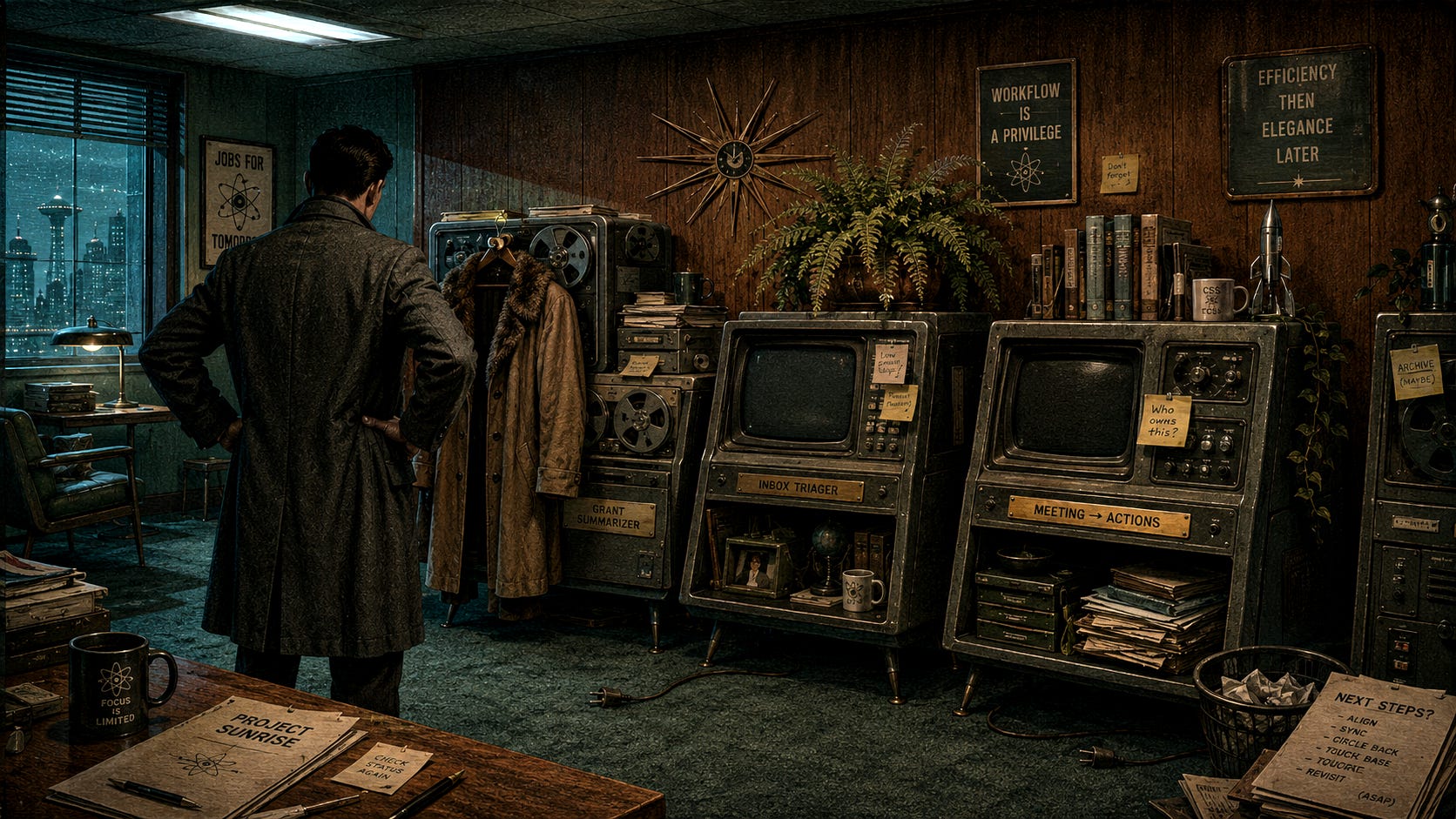
Tuesday, 8:00 a.m. sharp. A briefing materializes in my Obsidian vault. I didn’t write it. Didn’t even ask for it that day. It lists my calendar, points out that I’ve double-booked myself for two Zoom calls at 10 a.m., and, just to twist the knife, notes that the 7 to 7:50 a.m. outreach block is already toast. The machine is disappointed in me. Not even mad. Just disappointed.
I read it at 8:40.
The machine was on time. You could say I was… late to my future. (Sorry.)
A week and a half before this, I asked Claude to audit my AI habits. Where am I crushing it? Where am I a disaster? I went in feeling smug. I mean, I’ve done weird things with this tech. Fed 26 years of my blog into a wiki so it could spit my own words back at me. Built a skill library that mimics my writing style. Launched a bilingual phone agent that actually answers calls for a real movie theater. I figured I deserved a medal. Or at least a gold star. Something.
Instead, it said this:
You create pipelines but don’t schedule them. The difference between “Claude can do this” and “Claude does this every Monday at 8am without me asking” is what separates regular users from power users. You have everything you need, but nothing is set to run automatically.
And when I asked it to pick the single thing I should fix, out of everything:
Schedule things. You build excellent one-off workflows. The leap is making them recurring without you in the loop. That’s where the “I have a team” feeling comes from.
I spent a year building workflows. Ask me how many I actually ran in a given week. Go ahead. The answer is zero. Maybe one, if I was feeling ambitious.
You probably know the drill. Your team built that grant-summary thing back in March. Someone demoed it at a staff meeting. Everyone clapped. There’s an inbox triager floating around, and some tool that turns meeting transcripts into action items. They all technically work. But only if someone remembers to run them. Nobody likes to admit that part. It’s embarrassing. Like finding out your fancy treadmill is just a coat rack now.
Any workflow that needs a human to remember to start it is already on life support. Why? Because remembering is hard, and you already spent all your motivation building the damn thing.
I know this because my vault keeps track. I built that morning briefing months ago as a command I had to type. The file names reveal the pattern: April 20, 22, 23, 24. Then a twelve-day gap. Then May 6, 7, another gap, 11, another gap, 13, 14, 15, and another gap. Each gap is a morning I forgot to ask for the thing that’s supposed to remember for me. (I did eventually notice the irony. It took a while.)
The weekly digest finally broke me. I’d had the idea since April. Once a week, read everything I wrote in the last seven days, then dig through four thousand other notes and find connections I’d never think to search for. Not just keywords. Actual links. The audit called me out: you never built it. That stung, because the prompt was already written. Forty lines, just sitting there. The workflow existed. The part where it ran every week, without me, did not.
So I finally hooked it up to a clock. The briefing, the digest, and a weekly stats run for my Substacks, because apparently Substack thinks daily stats are too much to ask for. Tuesday, a few hours after that 8 a.m. briefing, the digest ran by itself for the first time. No human intervention. Miraculous.
What was delightful was that on its first solo run, the connection it surfaced was an essay I wrote about keeping journals for 28 years. The line it pulled? The vocabulary got better. The behavior didn’t move. The robot’s first act was to dig up my own words and diagnose the exact problem it had just patched over. I didn’t ask for that. Of course I didn’t.
Here’s the catch. I’m 49. For most of my career, “automation” meant a giant project. Budget, six months, a consultant, a kickoff meeting with a slide called Phase 1. That mindset sticks around. So we treat building the workflow as the big win, and scheduling as some mysterious second step for later. But now? Building the workflow takes an afternoon. Scheduling it is just a dropdown in the same chat app you already use. The only hard part left is admitting that ‘I’ll just run it when I need it’ actually means ‘never.’
That line from the audit—‘I have a team’—won’t leave me alone. Because that’s what’s changed. A team isn’t just headcount. A team is when work gets done without you poking it. You show up, and something is already finished, and nobody had to bail you out. By that standard, a scheduled task is more of a team than some actual teams I’ve worked with. You know who you are.
So here’s the move: if you’ve got a pile of clever one-off workflows—and you do—don’t build a sixth. Building another is fun, That’s why it’s a trap. Pick the one you keep running by hand. The grant summarizer, the triager, whatever. Set it to run on a schedule this week. See how it feels when it works without you. Spoiler: it’s weird. In a good way.
Next Tuesday, 8:00 a.m., the briefing will show up again. Whether I deserve it or not. It’ll list the calendar, flag the conflicts, and point out whatever I’ve already missed before I’m even out of bed.
One of us is reliable now.