
We Spent Twenty Years Pretending Hardware Didn’t Exist. AI Just Ended That.
The cloud promised infinite compute. Then AI called the bluff.

There is a used graphics card on eBay right now — three years old, previously owned by a guy who bought it to play Elden Ring at max settings — and it is selling for more than my first car. Not adjusted for inflation.
If you’ve spent your career a few comfortable abstraction layers above the metal — and if you came up in the cloud era, you have; that was the whole design — this moment is disorienting. Hardware matters again. Actual, physical, gets-hot-when-you-touch-it hardware. We spent twenty years being told we’d never have to think about it, and now it’s the thing everyone thinks about.
Let me back up.
Your computer has been the wrong shape this whole time.
A central processing unit (CPU) functions as the ‘brain’ of the computer, efficiently executing tasks sequentially. This design is well-suited for most computing activities, such as spreadsheets, web servers, and managing multiple browser tabs.
A graphics processing unit (GPU) is designed for parallel processing, containing thousands of simple cores that perform calculations simultaneously. This architecture was originally developed for rendering video game graphics, such as 3D scenes and ray tracing, which require processing millions of pixels at once. For decades, GPUs served a specialized, though profitable, market.
Then it turned out that modern AI — the transformer models behind ChatGPT, Claude, the image generators, all of it — is, underneath everything, mostly multiplying enormous grids of numbers together. Matrix multiplication involves billions of operations that don’t depend on each other, which means you can do them all simultaneously. How convenient, GPUs were built for exactly this! And folks who have tried to install or train a frontier model on their laptops may know the pain of training it on CPUs rather than GPUs. Because installing these things on CPUs isn’t slower in the “get coffee” sense; it’s slower in the “come back in a few centuries” sense.
The demand for high-performance graphics cards among gamers inadvertently supported the development of hardware essential for AI. Nvidia recognized this potential early and invested fifteen years in developing CUDA, a software platform that enabled GPUs to be used for applications beyond gaming. This foresight positioned the company as a leader in the current AI landscape.
We spent twenty years pretending hardware didn’t exist.
What makes the current moment so strange is that from roughly 2006 to 2022, the industry’s entire message was “stop thinking about hardware.” Seriously, that was the pitch: the cloud as someone else’s computer, more realistically an AWS server somewhere in Virginia, humming away in a server farm you’d never see. Need more resources? Click a button, conveniently tied to a different AWS server somewhere in Virginia. Compute power became ubiquitous, like tap water — you didn’t ask where it came from, you just paid lľ bill and complained when it got too expensive.
They even named a product category “serverless.” Serverless! There were servers. There were so many servers. The name was a promise that you, personally, would never have to care.
And it worked. I built things at startups for years without knowing or caring what physical machine ran them. Hardware was a solved problem, just as plumbing is: Boring. Invisible. Handled.
Then AI showed up and asked for more math than the tap could supply.
And now the abstraction has a leak.
The tap water metaphor only holds while there’s enough supply. The cloud made compute feel infinite and interchangeable — any server, anywhere, whatever. AI compute is neither of these.
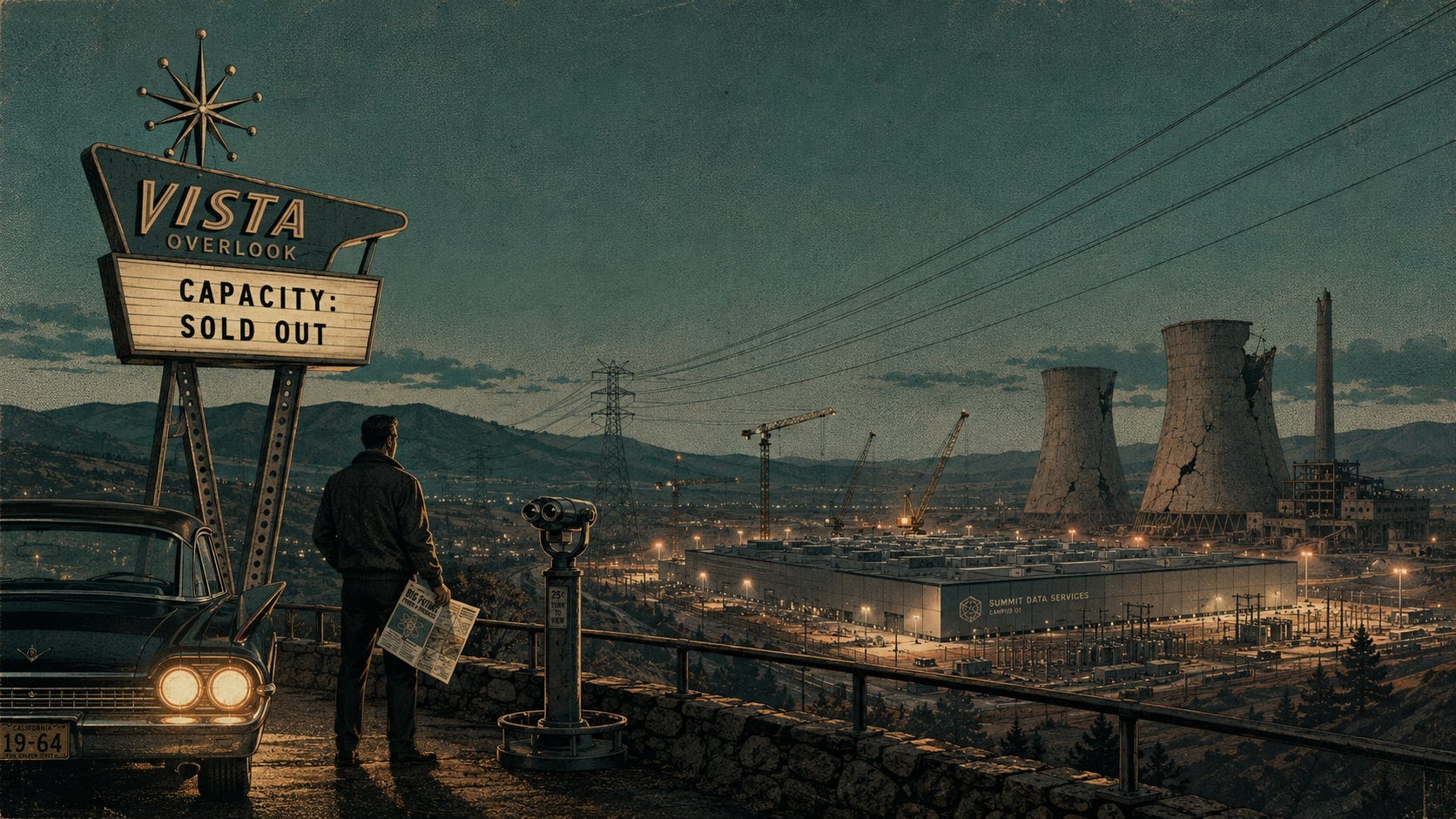
Training a big model requires tens of thousands of a specific chip, physically wired together with very fast interconnects, in one building, consuming enough electricity to run a small city. The bottleneck isn’t just the chips — it’s the high-bandwidth memory attached to them, the networking between them, and, increasingly, the power coming into the building, and the water required to cool everything down so the entire thing doesn’t combust. You can’t click a button for that. There’s a waitlist. For computers. In 2026.
So suddenly, everyone is an armchair Cloud or Server Farm Expert, I guess? Founders discussing grid capacity at dinner. Young people are calling for an end to AI because all the water in the world will be used up. People from utility companies showing up on tech earnings calls. “Sold out” — a phrase from PS5 launches — applied to enterprise data center capacity. Somehow, all this talk of the cloud sprang a leak, and what came dripping out is a whole bunch of resources being exhausted.
We didn’t stop caring about hardware because it stopped mattering — we stopped because it became so seamless that it became infrastructure.
I don’t know how long this lasts. Maybe the chips catch up, the shortage eases, and compute goes back to being tap water — boring, invisible, handled. That’s the historical pattern. Scarcity is usually a phase.
But right now, there’s a used graphics card on eBay worth more than a 1992 Toyota Corolla, and somewhere, a data center is being built next to a decommissioned power plant on purpose. If you’re feeling behind because you never learned what’s under the abstractions — now is, honestly, a pretty excellent time to learn.