
I've Been Wrong About the Internet Since 1999. It's the Best Credential I Have.
What twenty-five years of bad predictions taught me about which AI problem actually deserves the panic.

In 1999, I was certain that within ten years, writers would be paid in pennies.
Like, actual micropayments. A little coin dropping into a little slot every time a stranger read a thing you made. You’d write, someone would click, a nickel would land in your account, and the middlemen (the magazines, the labels, the gatekeepers who decided who got to eat) would just evaporate. We debated this passionately in the hallways in Austin during SXSW’s early years.
I believed this the way you believe things at 25: completely. For free.
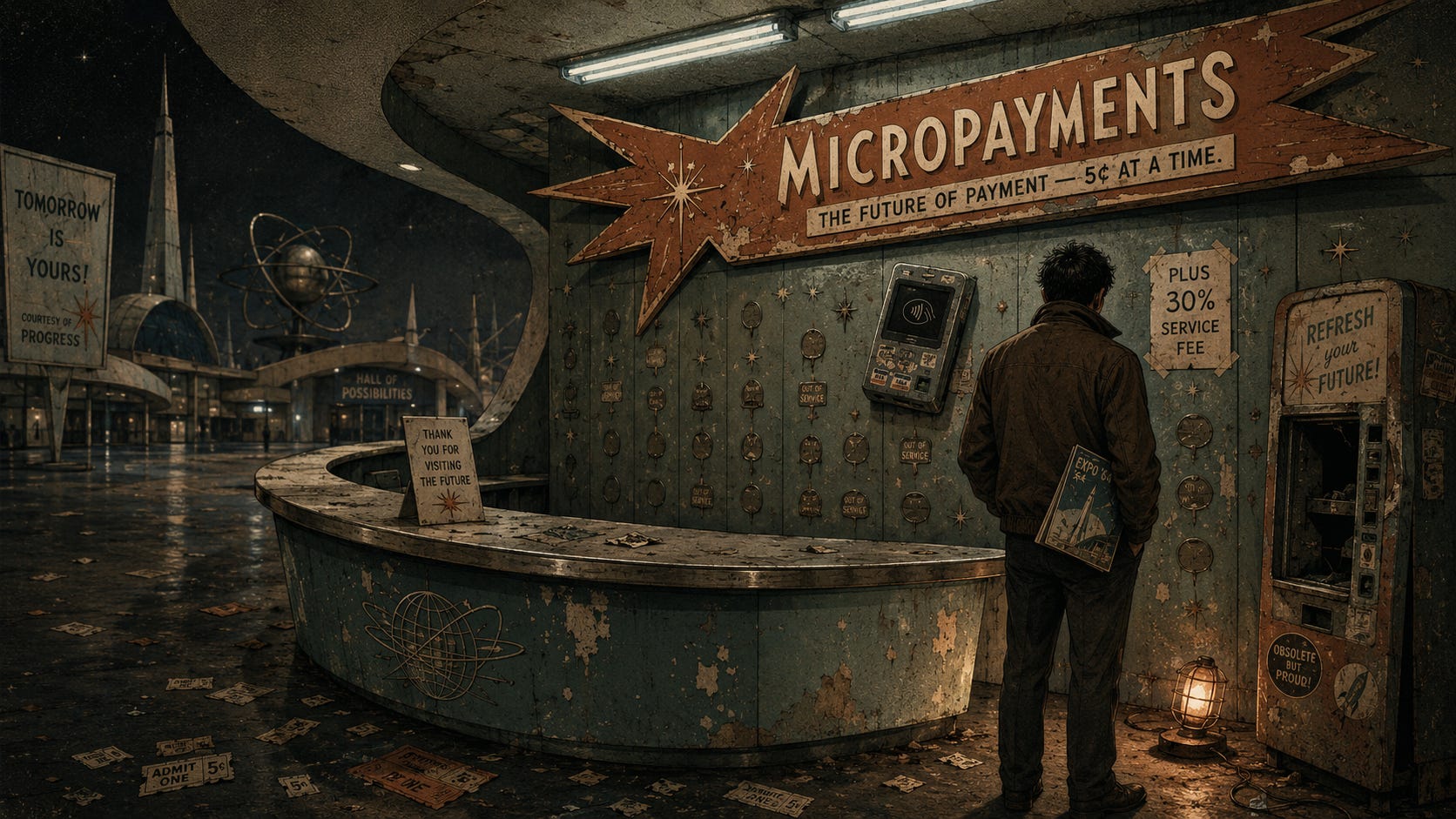
It didn’t happen. Clay Shirky made the canonical case against micropayments in 2000, and he was mostly right about paying a few cents to open a single web page. But then iTunes, the App Store, Patreon, and every Buy Me a Coffee button on the internet proved that people would make small digital payments—just not one nickel at a time, and rarely without a platform taking a cut.
The nickel turned into a couple of quarters. The middlemen didn’t evaporate. They became the payment system.
But that’s why being wrong about the internet in the late ‘90s counts for something. I’ve made enough mistakes with technology to lose my overconfidence, but not so many that I stopped paying attention. I bet almost nobody selling you an AI plan has that credential.
The last time every organization on earth had to learn something new all at once, in public, mistakes and all, was the mid-1990s. I was there.
What we got right
Access to information really did become more equal. In 1997, a kid with a library card and a modem could reach further than a tenured professor could in 1985. Email arrived fully formed and never needed a sequel.
In 2004, John Gruber — sick of wrapping his own writing in pointy HTML brackets — released Markdown, with significant contributions from Aaron Swartz: type *this* and get italics, write the way you already write in email. Two decades later it’s the native tongue of every large language model on the planet. When ChatGPT answers you in tidy headers, it’s speaking a format two guys invented to avoid formatting. The boring thing won. It usually does.
What we panicked about
Y2K. Planes, the power grid, the microwave. All of it felled by a two-digit year. Except it wasn’t — because thousands of programmers spent years quietly patching systems before midnight. The planes stayed up because of unglamorous maintenance work nobody remembers. What we remember is scanning the sky for falling 747s. I spent NYE 1999 at a rave. At midnight we confirmed everything was fine and went back to being too high on ecstasy to notice anything else. The panic became the story. The people who fixed it aren’t.
And the kids. A whole decade convinced Mortal Kombat and Parental Advisory stickers were breeding numb little killers. Congress held hearings. The generation raised on all of it grew up to be... anxious, mostly. Underpaid. Fine in the ways the panic swore they wouldn’t be, wrecked in ways nobody in those hearings was even looking at.
The thing worried about in public is almost never what actually causes the trouble.
What we missed
The quiet, structural stuff. We believed tech was a safe bet, recession-proof, learn-to-code-and-you’re-set. We thought “nothing on the internet is real” was a fringe concern. And we were certain that connecting everyone would fix loneliness, like houses lighting up after a power outage recovery. We built the most connected, loneliest generation in history.
Christmas Eve 2006. I drove my mother home after dinner, then sat alone in my apartment, in the dark, in sweatpants, watching men in Santa hats dance to Whitney Houston remixes through the window of the gay bar across the street. I had every tool my 1999 self had dreamed of. I could reach anyone. I didn’t want to reach anyone. No SEO strategy ever accounted for that.

So, AI.
Every AI panic conversation follows the same script: someone brings up Skynet, someone says the real threat is facial recognition bias, a third person explains with alarming confidence that AGI arrives in eighteen months, tops. Then everyone nods and goes back to ChatGPT rewriting their emails.
What we’re missing now
We are spectacular at worrying about the problem in front of us.
While everyone argues about AI consciousness and deepfakes, entry-level jobs are disappearing. Not eventually. Now.
I’ve been unemployed. I’m in my late forties; I took the career gap (caregiving, “finding myself,” the whole mess) and the re-entry path runs straight through junior roles. The “we know you’re overqualified, but we’d love to have you” bridge positions. Those bridges are getting pulled up, and I can feel the boards coming loose under my feet.
Stanford’s been watching this quietly, calling them “canaries.” Employment among software developers aged 22 to 25 has fallen nearly 20% from its late-2022 peak. Seniors held steady. The people with enough experience to direct AI are fine. The people who were supposed to build that knowledge by doing beginner work (the tickets nobody wanted, the boring stuff that teaches you how things actually break) don’t have a place to start anymore. The research stops short of blaming AI for every lost job. But it’s consistent with AI doing disproportionate damage at the bottom of the ladder — which is where you learn how things actually break.
People keep saying this is a young person’s problem. But a 23-year-old trying to get their first job and a 47-year-old who just spent two years keeping a parent alive are standing at the same closed door. The damage is slow and structural and won’t make the news until it’s already too late to be interesting.
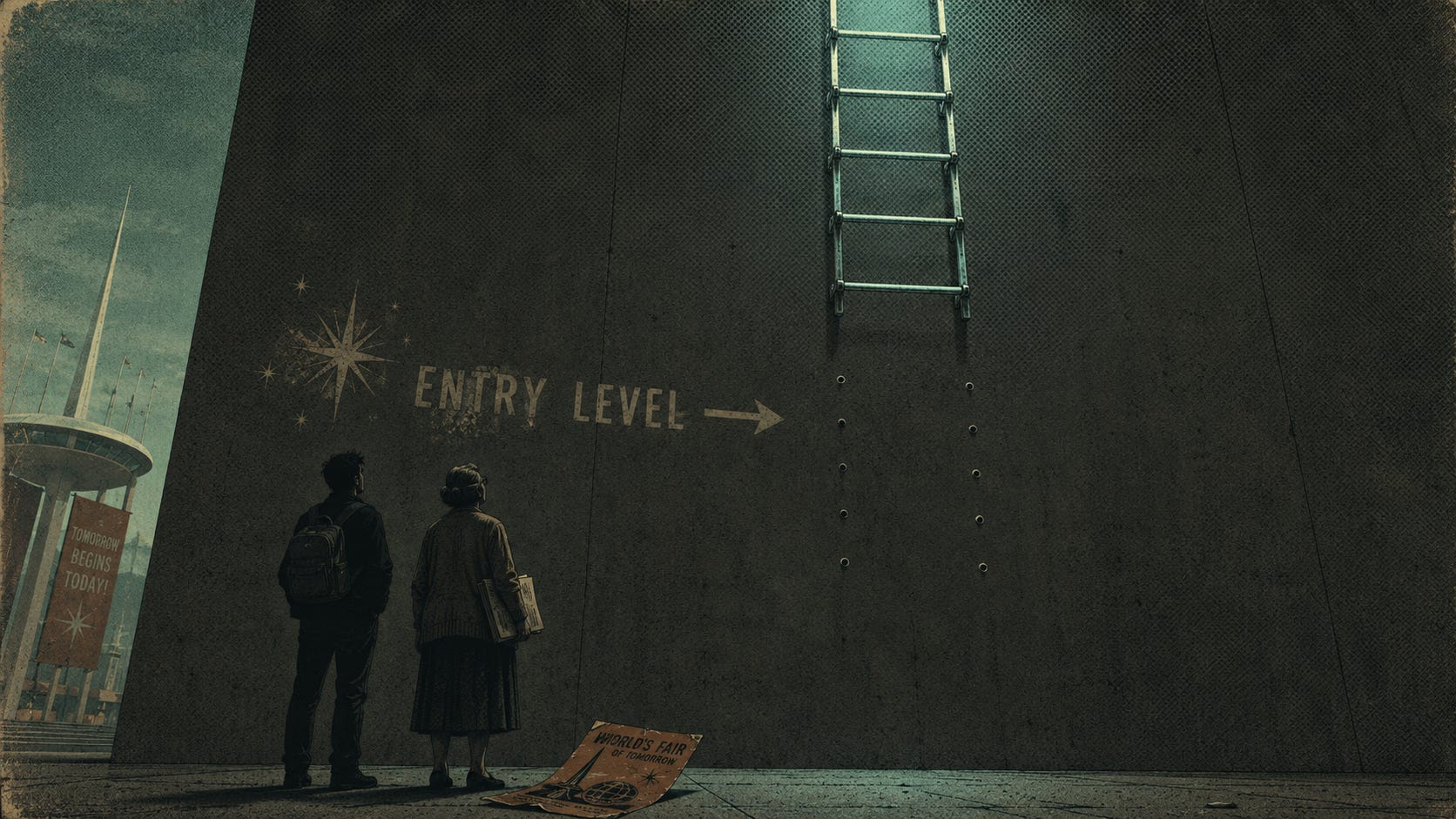
I don’t have a solution. What I have are things picked up being wrong about the internet for twenty-five years: ignore the panic, watch the unglamorous details. Who gets a first shot? What happens to the very first step?
The Christmas Eve in the dark. Sweatpants, Whitney Houston muffled through glass, no one to call. Nobody’s slide deck had a field for that.